
ShapeMaster User Guide
When in 2D View, this menu is accessed by right clicking mouse on a blank area of a drawing page.
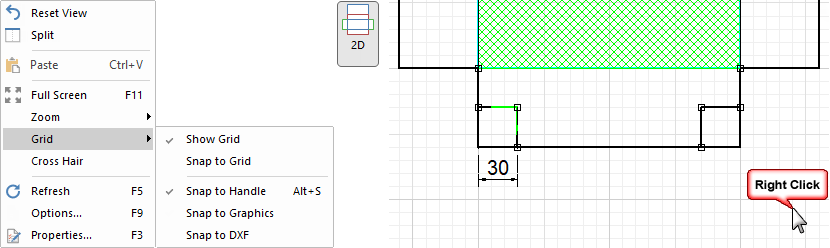 |
 click on the area of interest.
Reduces the magnitude of the view. This is useful if you lose the image.
This is especially useful when manually zooming in 2D View.
Before using the wheel to zoom in, click on area that you want to get a closer look at. If you loose focus, use the Reset View and try again.
Allows you to work in ‘List View’ while still being able to see the effect in other views by splitting the screen.
Keyboard Shortcut: Ctrl+V
Inserts a copy of the Clipboard contents onto the drawing page.
Keyboard Shortcut: F11
Expand the view to the entire screen.
To return to normal view, use Keyboard Shortcut F11 or 'Close Full Screen' button.
The term for changing the magnification is 'zooming'. You can zoom in to make objects appear large and to reveal more detail, or zoom out to see a larger portion of the plan.
If manually zooming in 2D View, before using the wheel to zoom in, click on area that you want to get a closer look at. If you loose focus, use the Reset View and try again.
For full discussion refer to topic on Zoom.
The Grid is just a series of lines arranged in columns and rows on the page and helps you line up objects visibly. It also allows for placement using the Snap to Grid snapping option, which can be turned on or off.
You should always have one type of snap enabled. Which one you use depends upon what you are trying to accomplish.
Toggles the use of grid snapping, which means that any object placed on the drawing page will automatically be moved to the nearest grid point for accurate alignment.
Snap to Grid is often used for positioning objects, ensuring that the cursor will 'jump' to whole units as defined in File Options.
When Snap to Grid is Off, the snap distance setting is set to a fixed pixel distance or a when On, a multiple of the grid density.
The display of the grid is independent to operation of the snap i.e. it is possible to have Snap to Grid activated but have the actual Grid hidden.
This means that you can have the grid hidden, yet still have objects snap to grid points.
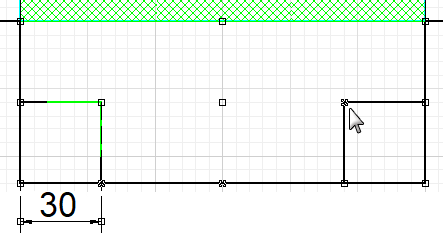
Toggles the use of handle snapping, which is not related to grids. Handles are the small squares on the corners and mid-points of rectangular objects.
Enabling handle snapping in 2D view means that when you place an object near another one, the handles on its corners will try and align themselves with the handles on the other object. The object will jump next to the other one as its handles overlap, meaning that aligns itself exactly.
It is also useful for accurately adding dimensions. The image shows handles on a flap with a dimension added to confirm the width of the added corner notch.
Controls whether you can snap to a graphics item.
This allows you to import a dxf.
Toggles the display of a large crosshair which extends all the way across the drawing page. To enable, ensure option is ticked. To disable, untick the option.
The crosshair is useful for aligning objects over the width of the page and is also used to Split Windows. It will Snap to Grid or Snap to Handle, if those options are enabled.
Keyboard Shortcut: F9
Not applicable for ShapeMaster.
Keyboard Shortcut: F3
Not applicable for ShapeMaster.
